How to write a UGC script for your ads
Write a UGC script in five beats: a hook in the first 2-3 seconds, the problem, your product as the fix, one proof point and a single call to action. Keep it to about 60 words for a clip under 20 seconds, or 75-120 words for a 30-second one.

How to write a UGC script step by step
A UGC script is a short spoken outline for one person talking to camera about your product. It is not a word-for-word speech. Write it in this order. If you are still deciding whether the format suits your store, start with our explainer on what UGC ads are.
The five beats
- Pick one viewer and one problem. Write a single sentence: who they are and what annoys them. Motion suggests choosing 3-5 key messages for a brief, so cut anything that is not one of them.
- Write the hook. Say it out loud; it should take 2-3 seconds at most. Meta says 65% of people who watch the first three seconds of a video go on to watch at least ten. Start with the problem in the viewer's words, for example "I tried three cleaners before this one." For more openers, see our list of Facebook ad hooks.
- Say the problem, then the fix. One or two sentences on what was wrong, then name your product and show it being used. Motion's template runs hook, problem, solution, value proposition, social proof, CTA, and limits value propositions to 2-3.
- Add one proof point you can show. A real customer review, a before and after on camera, or a count you can back up. If you have no proof yet, leave the beat out rather than invent one.
- End with one action. Match the words to the button on the ad: "Shop now" or "Book a call", not both.
How long should a UGC script be?
Shorter than you expect. Motion's guide puts the ideal under 20 seconds, about 60 words. Billo recommends 75-120 words for a 30-second delivery, and UGC Copilot's niche templates run about 30 seconds at 95-100 spoken words for a standard product ad. Meta's mobile video guidance is to deliver your message in 15 seconds or less.
For a first ad, aim for the short end. Cut any sentence that does not add the problem, the fix, the proof or the action.
What does a finished UGC script look like?
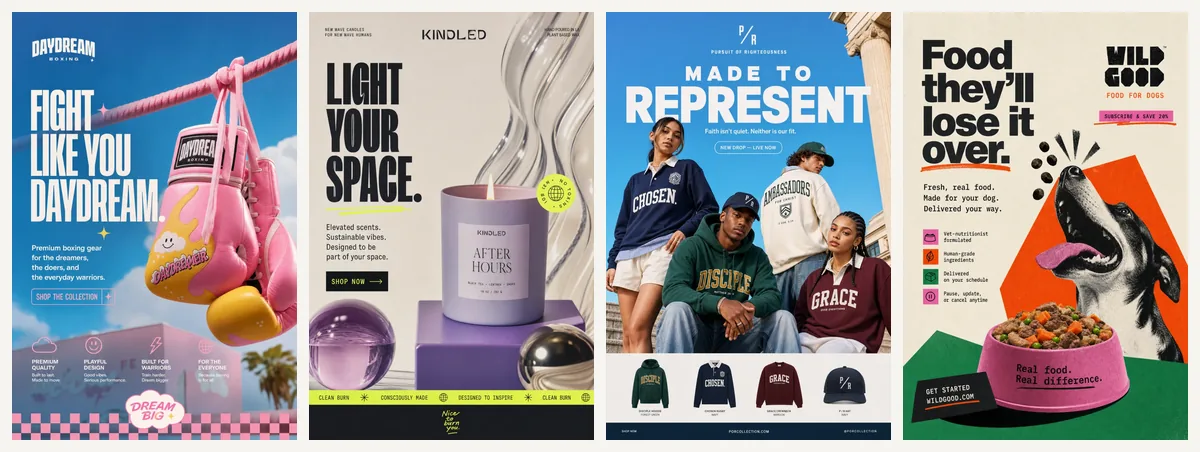
Here is a fill-in template with an example for a small candle shop. The example is ours, written for this page, not a real customer ad.
- Hook: "My last three candles smelled great for a week, then nothing."
- Problem: "I was tired of paying for a scent that disappears."
- Fix: "This soy candle from [shop name] is still strong on the second shelf of my kitchen."
- Proof: "Hold up the candle and the order page with your own review on screen."
- Action: "Link's below if you want to try one."
To fill it in, replace the quoted lines with your own problem, product and proof. Read it aloud once; if you stumble, rewrite the sentence in plainer words. See real UGC ad examples to compare structures.
How do you turn the script into a video ad?
The script is the same whether a human creator delivers it, you film it yourself, or ScaleShot makes it.
Hire a creator
Send the script as a guide, not a teleprompter. Billo's article says creators deliver better results when they can make the words their own. Motion adds that your brief should set the script approval process, revision limits and usage rights up front.
Film it yourself
Shoot vertical on your phone. Meta reports phones are held in portrait mode 98% of the time. Add captions: Meta's automated captioning tool generates them inside the ad creation tool for you to review, edit and save.
Make it with ScaleShot
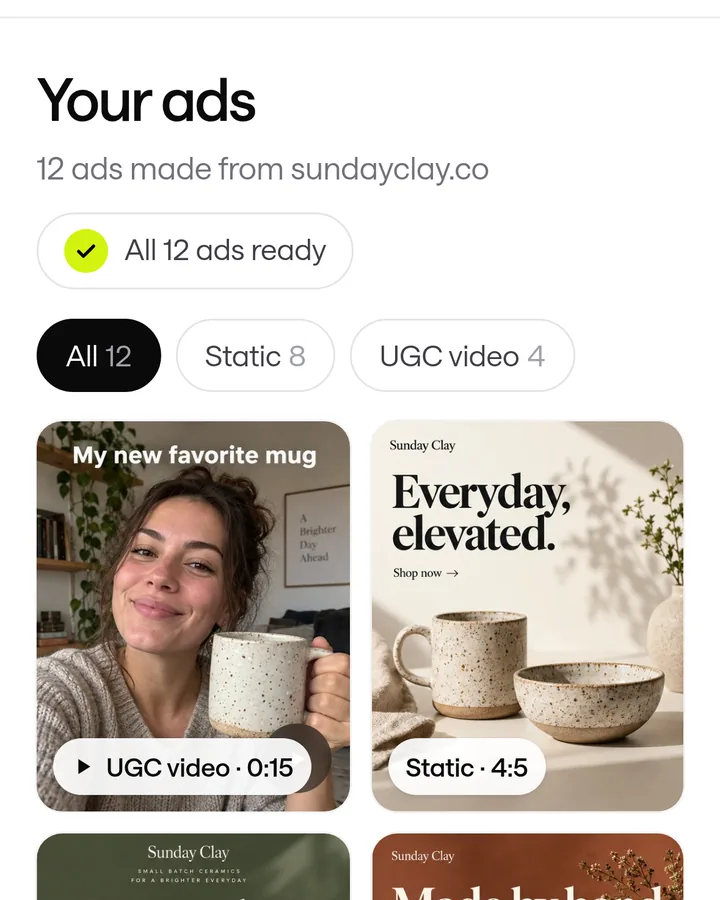
We built our Ads Agent to make AI UGC creator videos as 4-10 second clips, so split your script into one beat per clip. Video costs 10 credits per second, so a 10-second clip is 100 credits. Plans include 500, 1,000 or 2,000 credits per period, and the entry offer is $19.95 for the first 2 weeks. Our roundup of AI UGC video generators lists other tools and what each one makes. Our walkthrough on how to make UGC ads covers the full production steps.
What mistakes make UGC scripts fail?
- Over-scripting. Billo's article says viewers tune out when a creator sounds like they are reading a teleprompter.
- A slow opening. Spend the first seconds on the problem, not your brand name or history.
- Ignoring sound off. Meta found 70% of mobile video watching is with sound on, so a meaningful share is silent. Add captions; Meta's internal tests showed they raised average view duration by 12%.
- Invented proof. Fake reviews or numbers you cannot show will cost you more than a weaker script.
- Two calls to action. Pick one.
- No testing. Billo advises tracking metrics like hook retention and adjusting the script. Change only the hook between versions so you know what moved.
Common UGC script questions
Do I need a script at all?
Yes, but keep it loose. Billo says scripts should serve as guides, not strict rules.
Do UGC creators get paid?
Brands that hire creators agree scope, revisions and usage rights up front. Billo's script guide does not publish what creators are paid. If you film it yourself, the cost is your time.
Can I put the finished video on my Shopify product page?
Yes. Shopify's Media section accepts uploads from your device or a YouTube or Vimeo link, and video storage limits vary by plan.
Can ScaleShot run the finished ad?
With a connected Meta ad account, we launch Facebook and Instagram campaigns and ask before any change. We run Meta only, do not guarantee sales, and Meta bills ad spend separately.
ScaleShot TeamWe build ScaleShot, an AI ad tool for small businesses on Facebook and Instagram. How we make our guides
Sources
- Mastering UGC Scripts: Best Practices, Templates & Creator Insight, Billo
- How to Write UGC Scripts for Ads That Convert in 2025, Motion
- Free UGC Script Templates by Niche (2026), UGC Copilot
- Want to Make Better Video Ads for Mobile? Here's How, Meta for Business
- Capture Attention with Updated Features for Video Ads, Meta for Business
- Add media to a product (video upload), Shopify Help Center