How to turn customer reviews into ads
Pick a specific review from a real customer, ask their permission, and put their words on a simple image or in a short video. The FTC's Endorsement Guides say a testimonial must reflect the customer's honest opinion and can't claim more than you can prove. Meta also prohibits unauthorized endorsements.

Why reviews make good ads
A 2017 study from Northwestern's Spiegel Research Center found that a product with five reviews had a purchase likelihood 270% greater than one with none. The same research found purchase likelihood usually peaks for ratings between 4.0 and 4.7 stars, then falls as ratings near a perfect 5.0.
For ads, that means a specific review in plain words is usually a safer pick than a row of gushing five-star quotes.
How to pick the right review
The best review for an ad names a problem, the result and a detail only a real customer would know.
Here's an example with a made-up business, Northside Plumbing. Compare two five-star reviews:
- "Great service, highly recommend!"
- "Our water heater died on a Sunday night. Dan showed up by 8 a.m. Monday and had hot water running by lunch."
The second one is the ad. It shows the problem, the speed and a real name.
What to look for:
- A specific before and after in the customer's own words.
- Short enough to read in a few seconds, or a sentence you can pull out without changing its meaning.
- A worry other buyers share, such as price, speed or whether the product fits.
- A result you can back up. The FTC says endorsers can't make claims that would need proof you don't have.
How to get permission to use a review
Ask before you put anyone's words or face in a paid ad. Even a public review on Google is safer with the customer's yes in writing, and Meta's ad standards list unauthorized endorsements as a prohibited practice.
A simple process:
- Email or message the customer. Quote the exact words you want to use.
- Say where it will run (Facebook and Instagram ads) and how you'll show their name, such as "Maria G., Denver".
- Ask for a reply that says yes in writing, and keep it.
- If you shorten the quote, send them the shortened version too.
Don't edit a review to say something new. The FTC warns that asking customers to change or delete negative reviews can mislead readers, though you can ask them to add an update.
Three formats for testimonial ads
Quote card
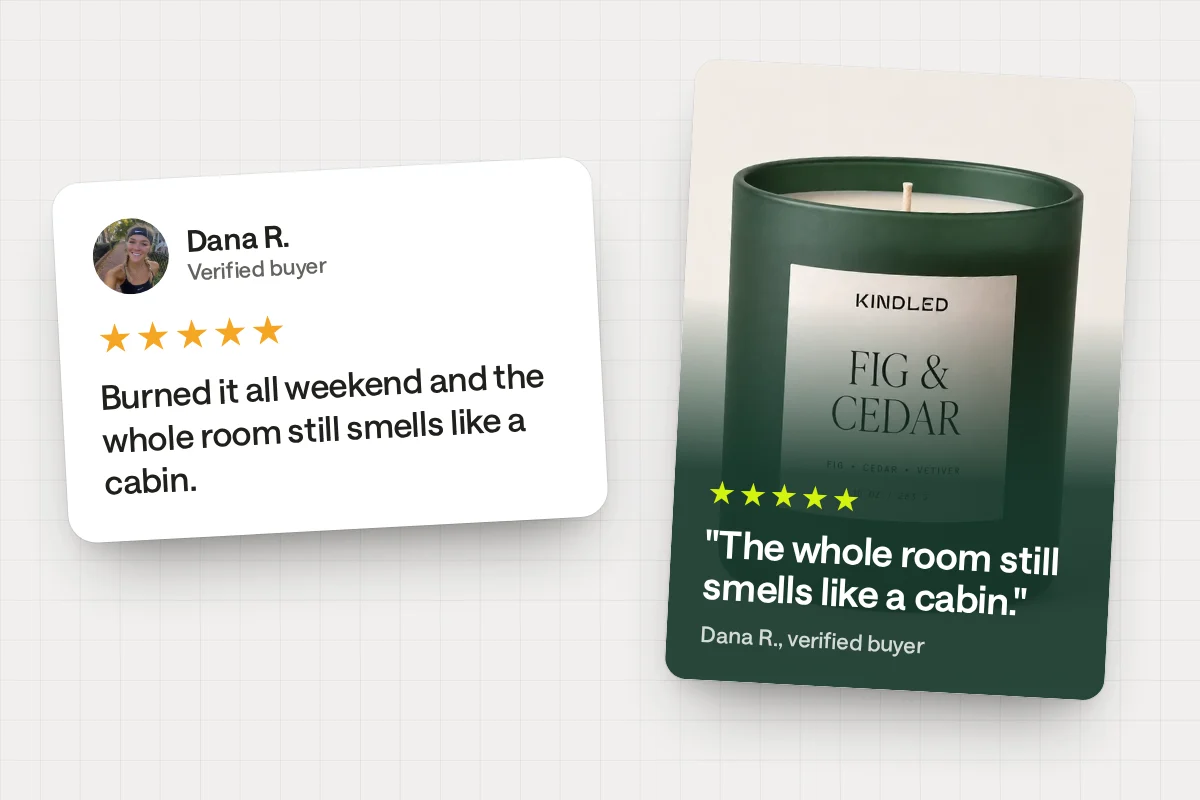
The customer's words in large type over a product photo or a plain background, with their first name and town. It's the fastest to make. See Facebook ad design for keeping the text readable on a phone.
Video testimonial
The customer talks to a phone camera for 15 to 30 seconds about what changed for them. Ask them to start with the problem. Add captions, which Meta's Feed video specs list as "optional, but recommended". Our guide to UGC ads covers filming and testimonial-style scripts.
Review screenshot
A screenshot of the review on Google, your site or Etsy, cropped clean, next to the product. It looks authentic because it is. Blur any details the customer didn't agree to share.
For Northside Plumbing, the Sunday-night review works as a quote card over a photo of Dan's van, and as a 20-second video if the customer will film one.

The FTC rules for testimonial ads
The FTC's Endorsement Guides FAQ sets the main rules:
- Honest opinions only. An endorsement must reflect the honest opinion of the endorser.
- Typical results. If a customer's result is unusual and you can't show it's typical, the ad must make clear what results people can generally expect.
- Disclose connections. Reviews from employees, friends or relatives need a clear disclosure of that link. So do reviews you paid for or rewarded with free product or a discount.
- No cherry-picked asking. Only asking customers you expect to be happy can mislead if it skews the results.
The FTC's rule on consumer reviews, announced on August 14, 2024, bans fake reviews, including AI-generated ones, and bans incentives that depend on the review being positive or negative. It lets the FTC seek civil penalties against knowing violators.
This is a summary, not legal advice. For claims about health or money, talk to a lawyer.
Meta's rules on claims in review ads
- No unauthorized endorsements. Meta lists them next to deceptive pricing as prohibited commercial practices.
- Paid partnership posts need a tag. If you promote a creator's branded content post, Meta's ad standards say the ad must tag the featured third-party product, brand or business partner using the branded content tool.
- Health results are restricted. Meta's Health and Wellness policy bans promises of specific outcomes within a set timeframe without disclaimers or qualifiers, and weight loss ads can't show a close-up of someone pinching fat. A customer quote like "I lost 20 pounds in a month" falls under these rules.
If an ad gets turned down, our guide to rejected Facebook ads explains how to appeal.
Making review ads with ScaleShot
ScaleShot's template library includes a bold testimonial layout that comes with your logo, colors and fonts already applied, and you swap in the customer's words. If you already designed a review ad yourself, upload it to the Library and it runs exactly as it is, with no AI changes.
Testimonial ad questions
Can I use Google reviews in my Facebook ads?
Ask the reviewer first. Meta prohibits unauthorized endorsements, and written permission is the simplest proof that you have it.
Can I offer a discount for a review?
You can't make the reward depend on the review being positive. If someone got a free product or discount, that connection needs to be disclosed.
Can I use AI to write customer testimonials?
No. The FTC's 2024 rule bans fake reviews and testimonials, and it names AI-generated fake reviews. AI can help you lay out a real quote, never invent one.
Do I need a "results not typical" line?
If the result in the testimonial isn't what most customers get and you can't prove it is, the FTC says the ad must make the generally expected results clear.
Does showing a verified buyer badge help?
Spiegel Research Center found that a verified buyer badge improved the odds of purchase by 15%.
ScaleShot TeamWe build ScaleShot, an AI ad tool for small businesses on Facebook and Instagram. How we make our guides
Sources
- FTC's Endorsement Guides: What People Are Asking, Federal Trade Commission
- Federal Trade Commission announces final rule banning fake reviews and testimonials, Federal Trade Commission
- Prohibited commercial practices, Meta Transparency Center
- Advertising Standards, Meta Transparency Center
- How online reviews influence sales, Spiegel Research Center, Northwestern University
- Health and wellness, Meta Transparency Center
- Facebook Feed video ad specs, Meta Ads Guide