What is a good ecommerce conversion rate?
A good ecommerce conversion rate is around 2% to 3%, the usual average in Shopify's guide. Many small stores sit lower. Littledata's August to October 2026 data puts the median Shopify store at 1.3% and the top 10% above 3.6%. Compare yourself with stores in your category.

How to calculate ecommerce conversion rate
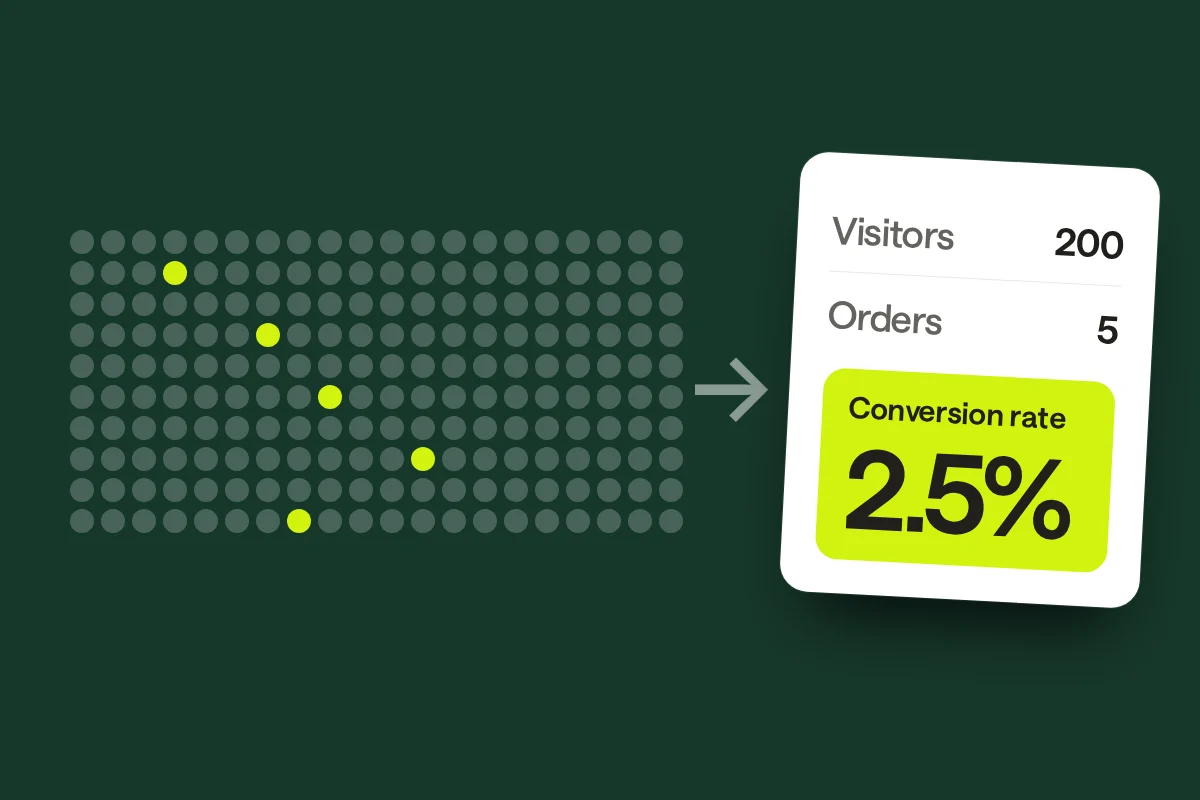
Conversion rate is the share of visits to your store that end in an order. The formula:
Conversion rate = orders ÷ visits × 100
Shopify's example: 50 orders from 1,000 visits is a 5% conversion rate.
A made-up example closer to most small shops: a dog treat brand gets 2,400 visits in a month and 36 orders. 36 ÷ 2,400 = 0.015, so its conversion rate is 1.5%.
Shopify counts visits as sessions. In its reports, each funnel step is that step's sessions divided by total sessions. One person who visits three times counts as three sessions, so a session-based rate reads lower than a per-person one.

Ecommerce conversion rate benchmarks for 2026
Benchmarks depend on who measured and which stores they counted. Here are the figures from named sources.
All stores
- Shopify's conversion rate guide, updated August 2026, says averages tend to sit around 2% to 3%.
- The same guide cites Dynamic Yield's global average of 2.66% and Statista's 1.4% for the first quarter of 2026.
- Littledata measured 438 Shopify stores from August 3 to October 31, 2026. The mean was 1.9%, the top 20% converted above 2.7%, and the top 10% above 3.6%.
By industry
Dynamic Yield's June figures, as cited by Shopify:
- Beauty and personal care: 5.32%
- Food and beverage: 4.58%
- Fashion and apparel: 2.77%
- Home and furniture: 1.29%
- Luxury and jewelry: 0.63%
Pricier categories sit lower on this list, so a furniture store at 1.2% may be doing fine.
By device
Sources disagree here. Contentsquare's retail data, cited by Shopify, shows 3.7% on desktop and 2% on mobile. Littledata's Shopify stores show a 1.5% median on mobile and 1.3% on desktop. Check your own split before you assume mobile is the problem.
Where to find your conversion rate in Shopify
Shopify's Conversion rate breakdown report shows where shoppers drop off:
- In the Shopify admin, go to Analytics > Reports.
- Click the Category filter.
- Click Behavior.
- Select Conversion rate breakdown.
The report shows four steps: all sessions, sessions with cart additions, sessions that reached checkout, and sessions that completed checkout. The Conversion rate over time report shows the share of visitors who buy, by day or week.
Read the funnel from the top. If few people add to cart, the product page is the problem. If many add to cart but few finish checkout, look at shipping costs and the checkout itself.
Fix 1: Make the store load faster
Speed shows up in sales. A study by Deloitte and the agency 55, commissioned by Google, found that a 0.1 second faster mobile site raised conversion rates by 8.4% for retail sites.
Shopify's speed advice for store owners:
- Remove apps that aren't essential for sales.
- Optimize images or show fewer of them.
- Resize images to match the size they display at.
- Avoid adding too many sections to your page templates.
Start with apps you installed for a test and never used again.
Fix 2: Better photos and real reviews
Shoppers can't touch the product, so photos and reviews do the convincing.
Photos
Show the product from every side, in someone's hand for scale, and in use. Add a close-up of the texture or label. Our guide to product photography covers lighting and setup on a phone.
Reviews
Northwestern University's Spiegel Research Center, in research first published in 2017, found that a product with five reviews was 270% more likely to be bought than one with none. Purchase likelihood typically peaked at ratings of 4.0 to 4.7 stars, so a few honest critical reviews don't hurt.
Ask every early buyer for a review by email a week after delivery. The first five matter most.
Fix 3: Show shipping costs early and shorten checkout
Surprise costs drive more people away than anything else Baymard asks about, apart from "just browsing". Baymard Institute's cart abandonment research, updated October 2026, found 40% of shoppers who abandoned a purchase said extra costs like shipping, tax and fees were too high, and 12% couldn't see the total cost up front.
- Put the shipping price and delivery time on the product page.
- If you offer free shipping over a set amount, say so in the announcement bar.
- Let people check out without an account. Baymard found 18% left because the site wanted them to create one.
- Turn on accelerated checkout buttons, which let customers go to checkout straight from the product page and skip the cart.
Baymard also found 17% left because checkout was too long or complicated, and 9% because there weren't enough payment methods. Its testing estimates that a large ecommerce site can gain a 35.26% increase in conversion rate from better checkout design.
Your traffic changes your conversion rate too
A store's conversion rate depends on who visits as much as on the store. Visitors from a broad ad who have never heard of you buy less often than past customers opening an email. When you start ads, expect the store-wide rate to drop for a while, and judge the ads by cost per order. If ad clicks don't turn into orders, our guide to Facebook ads that aren't converting goes through the causes.
ScaleShot makes image and video ads for your products through its Ads Agent. It can launch them as Facebook and Instagram campaigns with a Sales goal, which needs a Meta pixel installed on your site. Once they run, you can ask the Ads Agent how they are doing and it can pause ads after asking you.

Conversion rate questions
What is a good conversion rate for a Shopify store?
Above 2.7% puts a store in the top 20% of the 438 Shopify stores in Littledata's August to October 2026 benchmark. Your category matters more than the overall figure.
Is a 1% conversion rate bad?
Not on its own. It is below the usual average Shopify cites, but expensive items and new stores with mostly cold traffic often sit around there. Check the funnel to see which step loses people.
What is cart abandonment rate?
The share of shoppers who add items to a cart and leave without buying. Baymard's average across 50 studies is 70.22%.
How long before I can trust my conversion rate?
Wait for a few hundred sessions. With 100 sessions, one extra order moves the rate by a full percentage point, so early numbers swing a lot.
ScaleShot TeamWe build ScaleShot, an AI ad tool for small businesses on Facebook and Instagram. How we make our guides
Sources
- Ecommerce Conversion Rate: What It Is and How to Improve It, Shopify
- Ecommerce conversion rate (all devices) benchmark, Littledata
- Behavior reports, Shopify Help Center
- Milliseconds make millions, web.dev (Google)
- Improving your online store performance, Shopify Help Center
- Cart Abandonment Rate Statistics, Baymard Institute
- How Online Reviews Influence Sales, Spiegel Research Center, Northwestern University
- Accelerated checkout buttons, Shopify Help Center